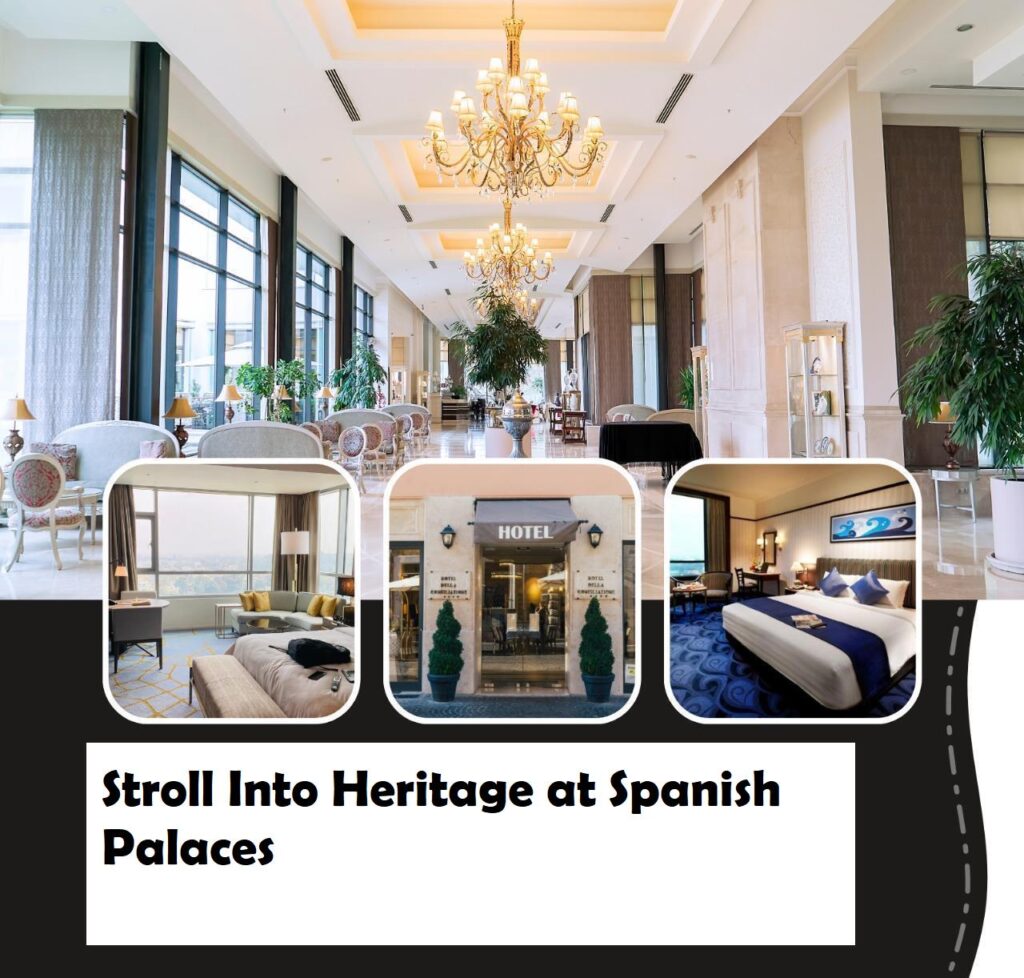
There’s a special hush that falls when you step through a palace gate in Spain—the kind that turns footsteps into whispers and sun into slow-moving gold. “Stroll Into Heritage at Spanish Palaces” is an invitation to enter that hush: to wander through courtyards cooled by orange trees, trace the geometry of azulejo tiles, and feel how stone—patient and dignified—stores the memory of empires, artisans, and royal rituals. This isn’t simply a stay; it’s an initiation into a living archive where hospitality is expressed in vaulted ceilings, silk-lined salons, and terraces that pour out over cathedral spires.
Andalusian Courtyards & Colonnades
Begin in the south, where palace life spills into open-air patios. Here, cloistered arcades frame fountains that chatter all afternoon, while the scent of jasmine floats across carved stucco. Breakfast arrives as a quiet ceremony—fresh figs, olive oil, and warm pan con tomate—served beside a marble basin where swallows skim the water. By day, sunlight paints lacework shadows along the colonnades; by evening, lanternlight glows amber across patterned stone. The cadence is unhurried, the atmosphere contemplative, and each corridor seems to promise a small, exquisite reveal.
Moorish Echoes, Modern Ease
Spain’s palaces are palimpsests: Islamic arches, Mudéjar ceilings, Renaissance symmetry, Baroque flourish. The beauty is in the layering—and in the serenity with which modern comforts tuck themselves into history. Heated floors beneath hand-painted tiles, whisper-quiet climate control behind sixteenth-century walls, bespoke linens beneath carved coffered ceilings. You’ll sip a citrus-forward vermut on a loggia the color of burnished apricot, then slip into a suite where a contemporary freestanding tub floats beneath cedar beams blackened by time. Every convenience is there, but always deferential to the room’s original poetry.
Art, Tapestry & the Night Salon
Palatial hospitality comes alive at dusk. A private viewing of a small chapel fresco; a guide’s fingertip stops at a thread in a tapestry, explaining how Toledo’s silk routes brought this shade of blue into vogue. In the night salon, velvet settees absorb quiet conversations as a guitarist rehearses for tomorrow’s courtyard recital. Candlelight corrals the room into little islands of intimacy. It’s easy to imagine a century folding back on itself—suddenly you are a noble guest, expected at supper, your place set with etched crystal and a stem of orange blossom.
Terraces Over Time
From a rooftop mirador, the city arranges itself like a timeline: Roman stones, Moorish towers, Gothic spires, and the clean lines of today’s boulevards. You watch the skyline deepen from honey to garnet, church bells loosen the air, and the palace seems to exhale. Down in the garden, a tiled rill gathers the last light, and a discreet attendant sets two glasses of cava beside a wrought-iron chair. Moments like these are why you came—to feel time dilate, to be surrounded by excellence that never needs to raise its voice.
Q&A: Planning Your Palatial Escape
What makes a “Spanish palace” stay distinct from a typical luxury hotel?
Provenance and craft. You’re inhabiting architecture shaped by centuries—stucco filigree, artesonado ceilings, cloister gardens—paired with present-day polish. It’s luxury that tells a story.
Which regions suit first-timers?
Seville and Granada for Moorish artistry; Madrid for grand salons and museum-rich days; Salamanca and León for Castilian gravitas; Toledo for layered medieval charm.
What room features should I request?
Ask for a suite with a historic ceiling (artesonado or coffered), a courtyard or garden outlook, and access to a private terrace or mirador. If you’re sensitive to sound, request interior-patio rooms; if you crave city views, opt for upper floors.
When is the best time to visit?
Late spring (April–May) and early autumn (September–October) balance warm days with softer crowds. In high summer, choose palaces with shaded patios and evening programming; in winter, look for generous salons with fireplaces.
Any etiquette tips?
Dress with relaxed elegance at dinner, keep voices low in historic wings, and treat original surfaces—tiles, plaster, woodwork—with reverence. Photography is usually welcomed, flash often is not.
Other palatial hotels to consider?
- Hotel Alfonso XIII, Seville (river-city grandeur and Andalusian courtyards)
- Gran Meliá Palacio de los Duques, Madrid (Habsburg-era grace near the Royal Palace)
- Parador de Granada (within the Alhambra complex’s serene precincts)
- Parador de Santiago—Hostal dos Reis Católicos (pilgrim-rich history on Obradoiro Square)
- NH Collection Palacio de Santa Paula, Granada (convent-cloister calm in the old quarter)
- Hotel María Cristina, San Sebastián (Belle Époque glamour by the river)
Conclusion: Where Heritage Becomes a Private Ritual
To “Stroll Into Heritage at Spanish Palaces” is to let time move at the speed of footsteps and sunbeams. You aren’t just checking in; you’re consenting to be curated—by architecture that guides your gaze, by gardens that quiet your breath, by service that anticipates desire before it articulates itself. In these palaces, exclusivity isn’t about velvet ropes; it’s about access to beauty that endures: a breakfast tray in a cloister at dawn, the hush of a chapel after vespers, the rustle of silk as a door is drawn for the night. Leave with the sense that you’ve touched something sovereign yet intimate—a chapter of Spain’s living heritage, written temporarily in your name.
