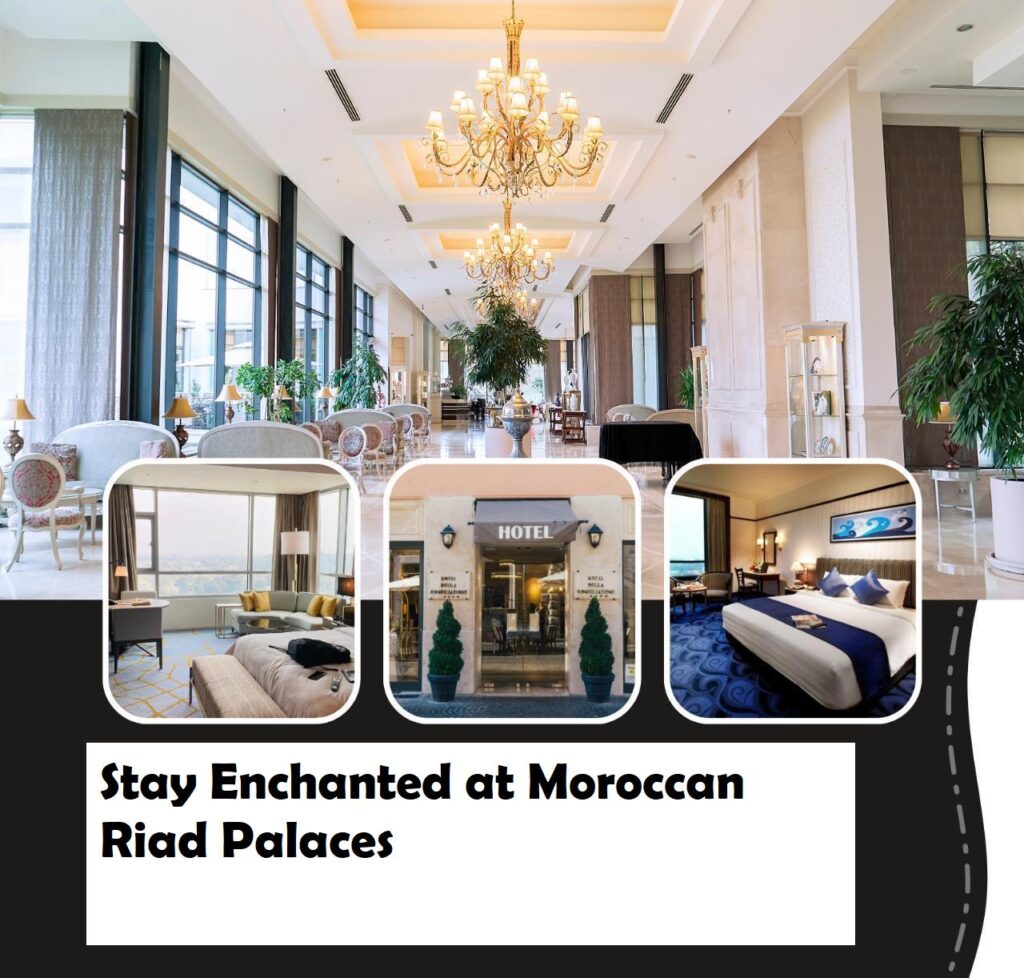
Step through a heavy cedar door and the city’s hum dissolves into a hush of water and birdsong. That is the spell of a Moroccan riad: an intimate palace turned inward, where life unfolds around a lantern-lit courtyard perfumed with orange blossom. “Stay Enchanted at Moroccan Riad Palaces” invites you to inhabit this quiet magic—where zellij mosaics glitter like constellations, mint tea cools the afternoon, and every corridor feels like a private gallery of craft and memory. Here, hospitality is not a script but a ritual, and time slows to the rhythm of a trickling fountain.
Courtyard Calm & Lantern Light
The heart of every riad is its patio: a geometric mosaic floor, a palm’s soft shade, and a marble basin that whispers with water. Breakfast appears in ceramics painted the color of the desert at dawn. Sun pours from above like liquid gold, while brass lanterns wait for evening to scatter starry patterns along whitewashed walls. You begin to hear the city differently—from a sanctuary that frames it, rather than fights it.
Carved Cedar & Zellij Artistry
Moroccan craft is a language; the riad is its literature. Cedarwood ceilings carry the scent of the Atlas forests, hand-carved into lacework that plays with light. Zellij tile blooms in hypnotic geometry—emerald, cobalt, honey—each piece set by hand. Plasterwork curls into arabesques; tadelakt walls glow like satin stone. In every surface, the human touch is preserved, so you feel less like a guest and more like a collaborator in beauty.
Rooftop Evenings & Atlas Horizons
As the call to prayer threads the sky, rooftops awaken. Terraces are edged with cacti and bougainvillea; low sofas invite you to stretch out beneath rose-pink clouds. The medina’s roofscape ripples toward the horizon, minarets pricking the light. A silver tray arrives with dates and almonds; someone adjusts a woven blanket at your shoulders. When the stars appear, the city becomes a murmuring sea and you float above it, unhurried and unseen.
Saffron Kitchens & Mint Tea Rituals
Riad kitchens honor the alchemy of spice. Saffron lifts a chicken tagine to a gentle glow; preserved lemon brightens tender olives; ras el hanout warms the night. Breakfast might bring msemen pancakes with honey and argan, or a basket of warm khobz and apricot jam. Between meals, mint tea is the house anthem—poured high to call down a crown of bubbles, offered whenever a conversation begins or ends.
Private Hammams & Slow Afternoons
A riad’s small hammam is your cocoon. Steam scented with eucalyptus, black olive soap smoothed into the skin, a kese glove to polish the day away. Afterwards, a courtyard lounger, a book, and a glass of fresh orange juice are all you need. The city can wait; the afternoon belongs to quiet. You will find rest not as absence, but as presence: of warmth, care, and meticulous attention.
Medina Doorways & Storytellers
Stepping back into the souks is like opening a novel mid-chapter. Leather, brass, rugs, and rosewater drift past in a caravan of color. Your riad’s key—often an old iron talisman—returns you to your secret address. The host asks about your wanderings and offers a tip whispered like a story: a hidden spice merchant, a rooftop with the bluest view, a calligrapher who paints names like blessings.
Q&A with Handpicked Recommendations
Q: What exactly is a “riad,” and how is it different from a hotel?
A: A riad is a historic townhouse built around an inner courtyard or garden, designed for privacy and tranquility. Unlike conventional hotels, rooms face inward, service is deeply personal, and craftsmanship—tile, plaster, wood—is the main event.
Q: I’m visiting Marrakech for the first time. Which riads balance style and soul?
A: Consider El Fenn for art-forward glamour and sweeping rooftops; Riad Kniza for classical elegance and gracious service; or Riad Yasmine for a photogenic courtyard and relaxed vibe. Each offers a distinct personality with that quintessential riad intimacy.
Q: I want maximum privacy with five-star polish. Where should I book?
A: The Royal Mansour Marrakech is a benchmark: individual private riads (with plunge pools, salons, and butler service) inside a walled estate. For opulent heritage in the medina, La Sultana Marrakech layers riad architecture with museum-level detail and a gorgeous spa.
Q: I’m drawn to craftsmanship and history. Any recommendations beyond Marrakech?
A: Head to Fez for refined artistry: Riad Fès blends Andalusian design with contemporary comfort, while Palais Faraj pairs panoramic city views with ornate zellij and carved cedar that celebrate Fassi tradition.
Q: Are riads suitable for families or small groups?
A: Yes. Many riads offer interconnecting suites or can be privately rented. Try Le Farnatchi for spacious suites and thoughtful dining, or Riad Kaiss for serene courtyards near key sights—both pair atmosphere with flexibility.
Q: When is the best time to visit?
A: Spring (March–May) and autumn (September–November) offer warm days and cooler nights—ideal for rooftop dinners and medina strolls.
Conclusion: Your Private Chapter of Morocco
To Stay Enchanted at Moroccan Riad Palaces is to claim a private chapter of Morocco—one written in lantern light, tiled geometry, and the generosity of hosts who make beauty feel effortless. You do not merely pass through a city; you inhabit its most intimate rooms, hear its quiet heartbeat, and carry away a sense of belonging that feels rare and unmistakably yours. In a world of predictable stays, a riad is an exclusive experience: hand-touched, human-scaled, and forever luminous in memory.
